

a reflection: “look at the moon”
on shared attention and the in-between hours


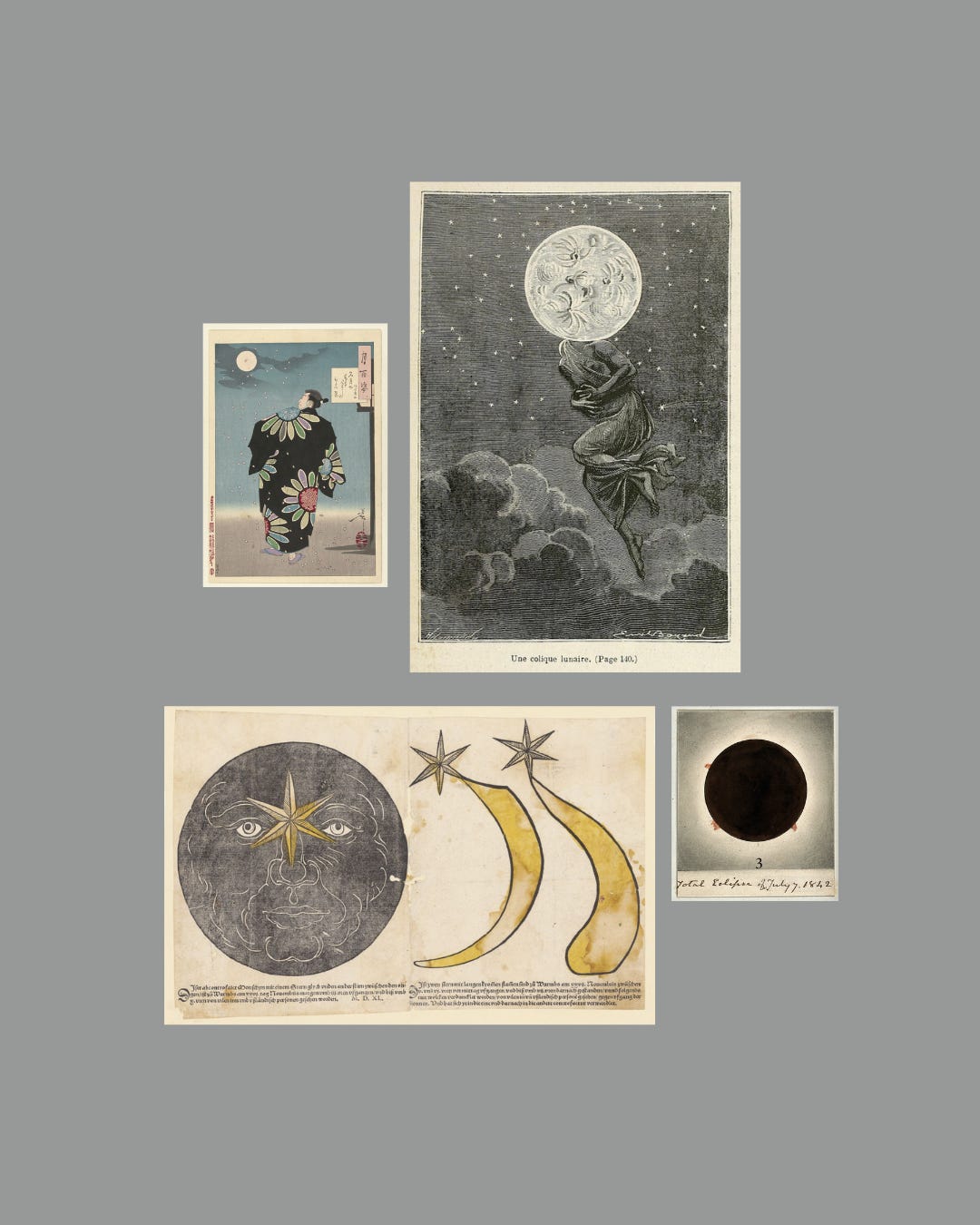
“Look at the moon” is a gesture of shared attention. Saying it can mean many things - it’s a soft invitation: look, come into my world for a moment; look, we’re here together; look, we’re part of something much bigger than us; look, here’s a reminder that we’re not alone; look, here’s a moment to be present; look, regulate with me. Underneath, it carries tenderness: a way of staying close in silence, an invitation to pause, a moment to slow down enough to notice what’s happening inside.
And maybe part of why I’m always saying “look at the moon,” “look at the birds,” “look at the sun,” is because that’s how I connect with others. It’s the language that feels most natural to me - looking outward rather than inward, sharing what I notice rather than explaining what I feel (often before I’ve even processed it myself). These gentle gestures give me a way to regulate, and a way to connect with myself and with others. This shared attention makes connection feel gentler, so I don’t slip into shutdown or disappear into overwhelm.1
They invite the other person into the pause with me - into a moment of quiet they might not usually take. I like silence; I need it. Silence is how I regulate, how I sense what I’m feeling, how I stay in my body. Silence isn’t comforting for everyone, but for me these gestures create a shared stillness - a way to be together without filling the space, to meet inside a moment that asks nothing more of either of us.
What I’m really saying is: come stand in this moment with me, even if the words never appear. Paying attention to something outside myself gives shape to what’s happening inside; it offers a small pause, enough space to notice what I’m feeling without being swallowed by it. When I gesture toward the moon or the sun, I’m also gesturing toward the part of myself that noticed them - the part that wants connection, but gently, in a way my system can hold. These moments become a bridge between my inner world and someone else’s. They’re small offerings, tiny openings - a quiet way of saying: this is where you can meet me, if you’d like.
These moments remind me how much my nervous system depends on gradual transitions. Transitions have always been difficult for me to cope with; the shift from day to night unsettles something in me. I call it the in-between hours - the stretch between 4 and 7pm. It’s a form of micro-liminality: the hour when the world exhales and the day begins to fall away. A time when the mind and body are meant to loosen, to move from doing to being. But mine doesn’t move so easily. The shift leaves me hollow, restless, overwhelmed, disoriented, and frozen. It feels as though the transition outside me is moving faster than the one inside me.
For a long time, I moved through the in-between hours without really understanding why the transition felt so overwhelming. I kept wondering why it affected me so deeply, and it wasn’t until I began paying attention to what was unfolding around me - the sky, the birds, the wind - not just inside me, that it finally made sense.
The body responds to light more than we realise: as the sun lowers, cortisol dips, the parasympathetic system begins to wake, melatonin rises in tiny increments, and the brain loosens its grip on the day.2 Our circadian system registers this shift instantly, but the rest of us doesn’t always follow on cue. Some nervous systems feel these changes too intensely, too slowly, or out of sequence - the senses begin winding down while the mind stays braced, or the emotions soften before the body knows it’s safe to let go.
It creates an internal misalignment - a lag between systems. The world is dimming, signaling ‘slow down,’ but the body is still carrying the charge and momentum of the day. For some of us, that mismatch isn’t subtle; it’s a tug-of-war between rhythms, a transition that asks more of the nervous system than it can seamlessly give. The discomfort isn’t resistance; it’s the body searching for its footing as the world changes around it. And often, dusk brings forward the feelings we pushed aside all day - the ones that surface only when the world grows quiet enough to hear them.
Together, the fading sun and the rising moon make the in-between hours feel less like something happening to me and more like something happening with me. They turn that vulnerable part of the day - when my system usually slips into restlessness or shutdown - into a place I can meet slowly, inside my body, without bracing against it.
There’s something steadying in knowing I’m not the only one who looks up. The sun doesn’t belong to me; the moon doesn’t belong to me. Somewhere - earlier, later, elsewhere - the people I love and people I’ll never meet also look up. We’re scattered across different places and different lives, but connected by this quiet act of noticing. The sky becomes a threshold - a place where inward and outward meet. A way to stay with myself while staying connected to something larger, something shared.
But lately, I haven’t been watching the sun or the moon. The ritual slipped away quietly, almost without me noticing. As the light changed, my body did too: tension rising, breath shortening, my body freezing. The in-between hours felt harder to meet, as if my body flinched before my mind understood why. It wasn’t deliberate, it was protective. My body turning away from a moment it wasn’t ready to feel. I wasn’t avoiding the sky; I was avoiding what it brings forward in me.
Still, the sky waits. The sun lowers; the moon rises. Whenever I’m able, I can return to the in-between hours slowly. I’m learning to meet this transition with more softness - to let small rituals hold me: light an incense stick, crack open a window, make a cup of tea, turn on a lamp. They’re small cues that say, “The day is softening now, and you can soften with it.” They don’t erase the discomfort, but they give it shape - something I can meet instead of avoid, a way to co-regulate with the world rather than brace against it.
Maybe that’s all this ritual really is: a way of telling my body, I’m here. I’m listening. I won’t rush you through this.
So when someone says, “Look at the moon,” or “Look at the sun,” listen closely. It’s never just about the sky. It’s an invitation into a moment where the world slows enough to let us feel - where connection doesn’t require words, and where you’re allowed to just be. It’s a small way of saying: this is where you can meet me.
Many neurodivergent or highly sensitive nervous systems experience state changes more intensely. Transitions - even gentle ones - can feel abrupt internally because sensory, emotional, and physiological shifts don’t always sync
Light is the primary regulator of the circadian system. As daylight decreases, cortisol naturally lowers, melatonin begins to rise, and the parasympathetic nervous system becomes more active - preparing the body to unwind.
beautiful read! thank you for writing this and sharing how you feel. I guess as life goes on, there are certain things, bigger than us, which will always remain, it's also a safety net.