

a discovery: the octopus
on curiosity, shapeshifting & the intelligence of the body


The octopus: three hearts pumping blue blood, skin that flickers from rock to coral to shadow in the blink of an eye, arms that think and taste and decide. It is both alien and intimate - a living reminder that the world remains more intricate, more alive, more enigmatic than we can fully fathom.
Only around a quarter of the ocean floor has been mapped in detail; large stretches remain uncharted, and countless depths, ecosystems and mysteries untouched. We have sent astronauts to the moon and probes beyond the edges of our solar system, yet the deep sea - the octopus’s home - stays largely out of reach. What’s strange is that this isn’t a distant world. It is our own water, our own planet, a wilderness we live beside but rarely meet.
Perhaps that’s why the octopus fascinates us. It rises from a place we can’t fully see, a world that mirrors the hidden parts of ourselves: the instincts we ignore, the depths we haven’t explored, the versions of us we haven’t met yet.
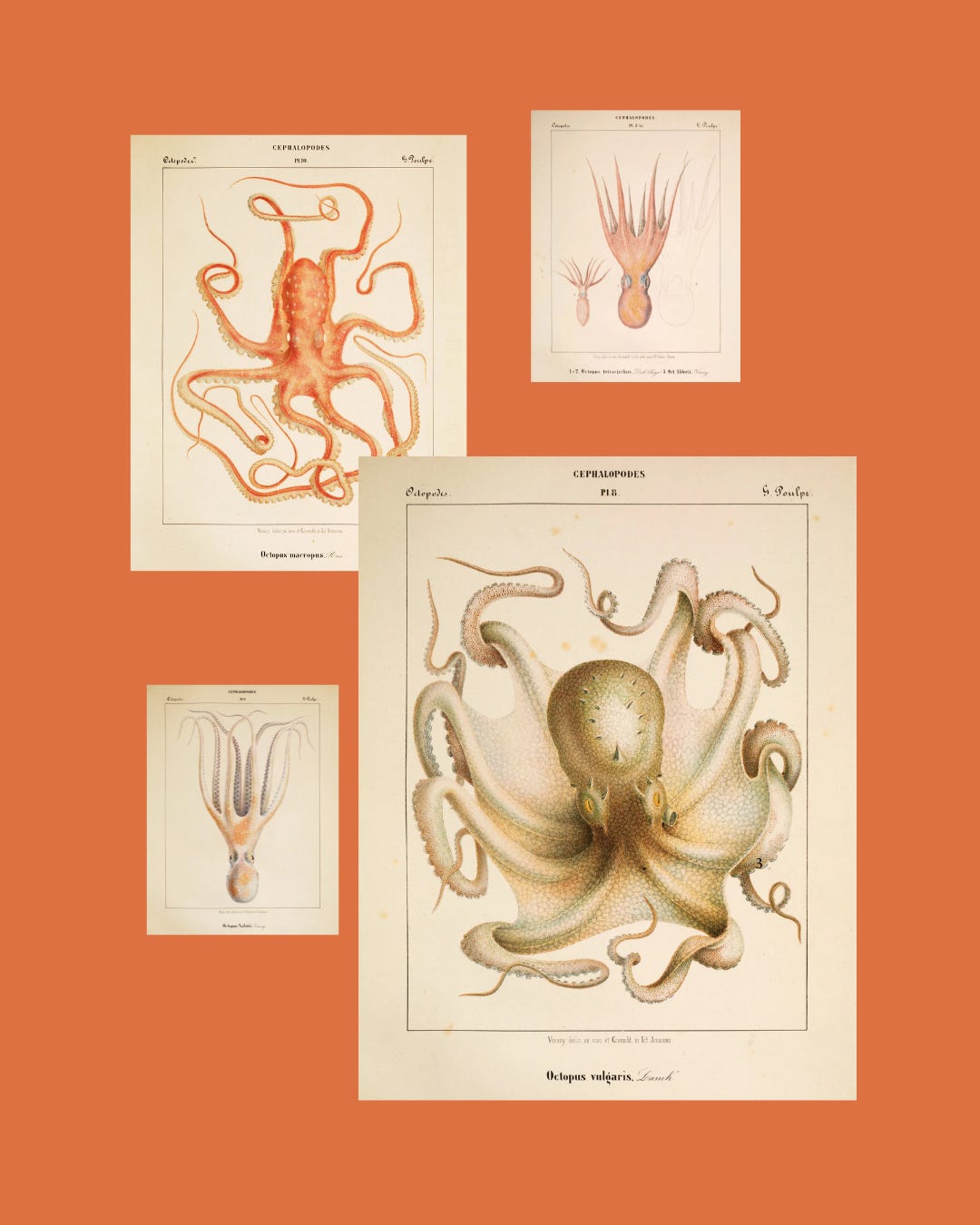
Five hundred million years ago, our evolutionary paths split. We became creatures of bone and structure; they became soft-bodied shapeshifters. Philosopher Peter Godfrey-Smith writes in Other Minds: “Meeting an octopus is like meeting an intelligent alien.” Yet in their vigilance, their play, their curiosity, they feel uncannily familiar.
Two-thirds of an octopus’s neurons live not in their head but in their arms. Each arm can taste, touch, explore, and decide without asking permission from a central brain. Researcher Sy Montgomery, in The Soul of an Octopus, describes touching an octopus as a kind of contact with “another mind.” The octopus doesn’t separate sensing from thinking. Awareness moves through its whole body - fluid, immediate, intuitive. It makes me wonder: what would it feel like to live in closer conversation with our own signals?
The human body has its own nervous-system intelligence, a pre-verbal way of signalling what’s happening beneath the surface. A stomach tightens long before the mind names fear. A chest softens before we realise we’re safe. It’s why, in moments of overwhelm or tenderness, someone might ask, “Where do you feel that in your body?”
But the mind - with its interpretations, predictions, and old survival strategies - often overrides these early cues. Cognition steps in too quickly, explaining, minimising, rationalising, while the body simply signals what’s true. We learn to think instead of notice, to analyse instead of feel. And yet the body keeps signalling, quietly and consistently, trying to speak first.
We tend to shrink “intelligence” to the brain alone, forgetting that the nervous system stretches through the entire body. The octopus embodies this fully: thought and sensation distributed across its limbs, awareness that doesn’t need to funnel itself through one central point. Its whole body participates in knowing.
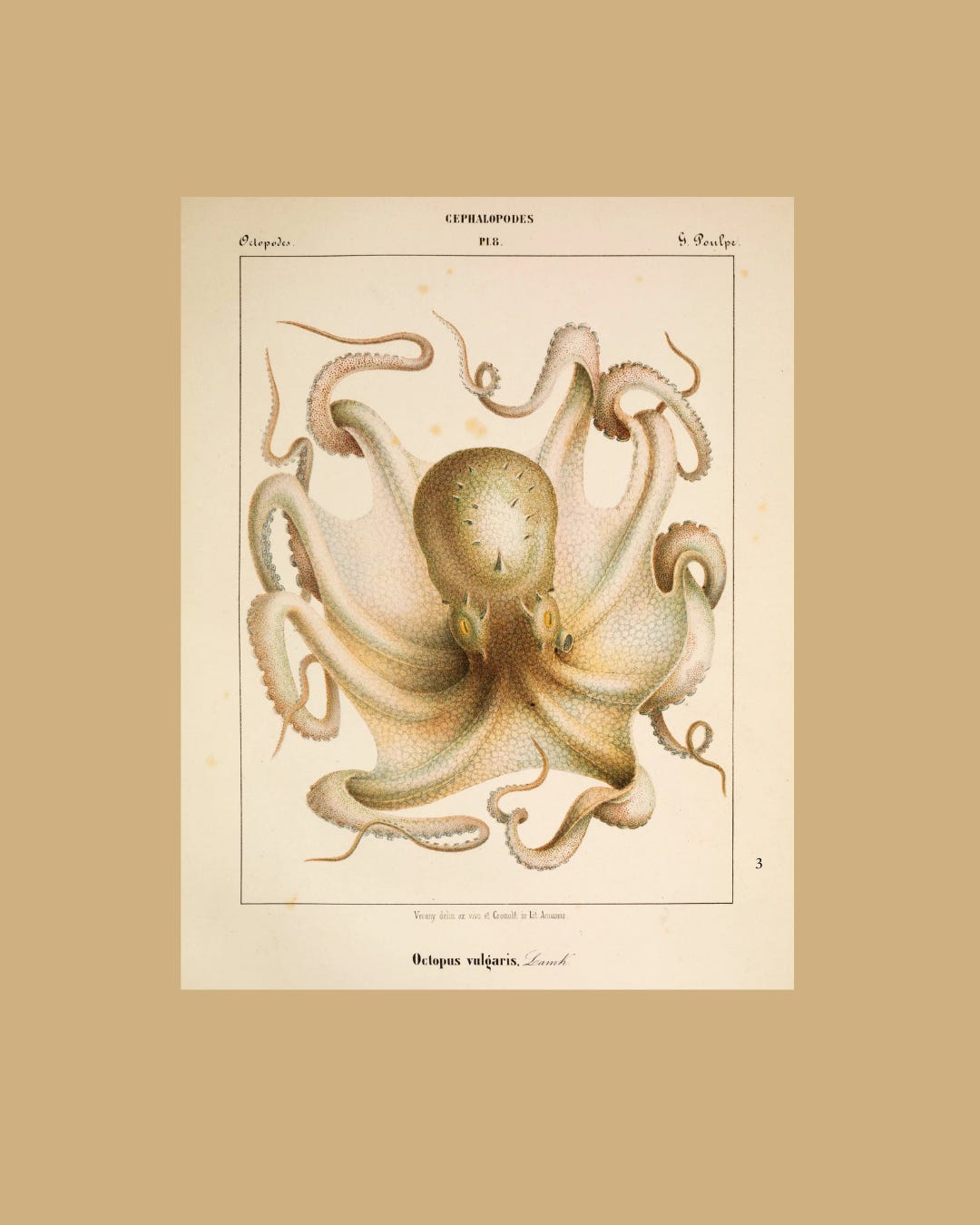
The same distributed responsiveness that lets the octopus change in an instant is what allows it to survive. When something shifts in its environment, the body reacts before the central brain has fully registered the threat - colour, texture, and posture rearranging themselves in a heartbeat. If startled, an octopus can almost disappear. Chromatophores flare open in bursts of pigment; tiny muscles lift the skin into spikes and ridges; its outline collapses into rock, coral, shadow. A creature made for metamorphosis.
And beneath this shapeshifting is another strangeness: octopuses can rewrite their own biology on the fly. Unlike humans, who mostly rely on fixed genetic instructions, octopuses heavily edit their RNA - changing how their proteins function without altering the underlying DNA. Researchers estimate that in some species, a large proportion of neural transcripts can be altered - sometimes more than half in certain species. In other words: they adapt at the molecular level. They are built for flexibility, for continuous revision. It is adaptation written into flesh.
We, too, are shapeshifters. We soften, sharpen, mask, reveal. Different parts of us step forward depending on what the moment demands: the protector, the performer, the observer, the dreamer. Some shifts are about survival and the nervous system adjusting our behaviour before the mind has time to analyse. Others are about belonging, about finding a place to land.
These shifts often happen pre-consciously, shaped by past experience and the body’s need to stay safe. And some of us shift more than others. Our nervous systems learn early which parts of us feel safe to show and which need to stay out of sight. Some people camouflage to avoid danger, others to belong, others because the world wasn’t built for their sensory processing needs.
This is adaptation - the body and mind organising themselves for safety. Some of these patterns are essential, especially in a world not built for every nervous system. But even protective strategies can outlive their usefulness. They keep us safe… but they don’t always help us grow.
So maybe the question isn’t whether we shift - we all do. The question is: what is this adaptation trying to secure for me? Safety? Belonging? Predictability? Relief? And is it still serving me now, or simply repeating an old pattern the body once needed? Because we can shape-shift in more than one direction. We can adapt toward survival, yes - but we can also adapt toward becoming. Toward the life that fits who we are now (or always were), not just who we needed to be.
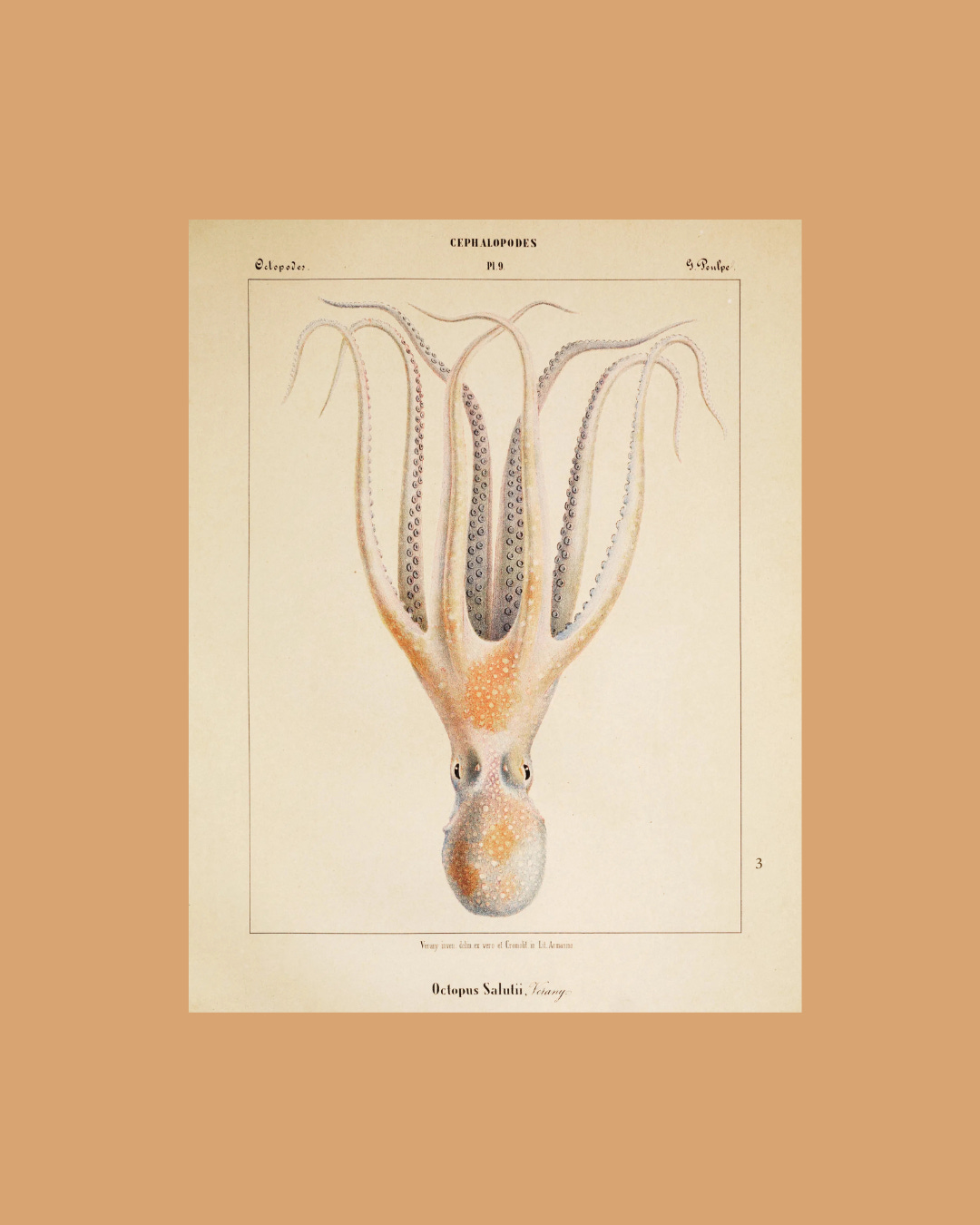
And then there is their curiosity. Octopuses explore. They investigate. They experiment. Jennifer Mather, one of the leading researchers on cephalopod behaviour, has observed that each octopus develops its own behavioural style - bold, shy, curious, wary - almost as individual as fingerprints. Their personalities emerge in how they approach the world.
Scientists still debate why octopuses are so curious, but one idea keeps resurfacing: they need to explore to survive. Octopuses are short-lived, solitary, and soft-bodied. They have no shell, no bones, and no guarantee of safety in an ocean full of predators. Some researchers suggest that this vulnerability may have favoured rapid learning and constant investigation. If everything around you can harm you, you learn by touching, testing, trying. Exploration becomes safety.
One octopus in a German aquarium learned to squirt water at a particular overhead light until it short-circuited - repeatedly. Another, Inky, slipped through a tiny gap in his tank, slithered across the floor, and escaped through a drainpipe back into the ocean. Others unscrew jars from the inside, open child-proof bottles, play with toys, dismantle equipment, and rearrange their tanks just to see what happens.
For a creature that may only live a year or two, play becomes a form of intelligence - a way of mapping the world, testing possibilities, learning what keeps you alive.
Humans often forget how to play. We treat curiosity as something to outgrow, wonder as something to hide, play as something to apologise for. We grow so fixated on what’s useful, responsible, expected, and our ability to find joy slips away without us even noticing.
When was the last time you did something simply because it delighted you? When was the last time you let yourself wander toward something simply because it pulled at you? When did you last explore something with no purpose other than the joy of discovering it?
The octopus suggests that curiosity isn’t childish - it’s adaptive. It’s how a mind stays alive to the world.
Curiosity follows them into sleep. In slumber, they cycle through rapid, vivid colour changes - flashes of coral, ink-black, sand-white - patterns that resemble hunting, hiding, courting. No one knows for sure what this means, but some scientists believe it may be a form of REM sleep, a kind of visual dreaming. A creature so different from us might still rehearse its life in the dark. There’s something profoundly human in that possibility: that even an alien mind might carry an inner world.
Divers often describe a moment when an octopus studies them - slowly, deliberately. Sy Montgomery calls them “curious, flexible, wild minds.” When an octopus reaches out an arm, it is not just exploring you - it is wondering about you. There is intimacy in that moment: a sense of being met by something wholly other, yet somehow familiar.
It loosens the human-centred idea of consciousness. It reminds us that awareness is not ours alone - it is something we share across the wider web of life.
And all of this - the intelligence, the curiosity, the play - exists alongside an astonishing brevity of life. Most octopuses live only a year or two. Many spend their final weeks tending eggs they will never see hatch. Their brilliance unfolds quickly and burns out fast. There is something almost mythic in that: a life defined not by length, but by intensity, by presence, by the urgency to explore while time is still unfolding.
Maybe what the octopus offers isn’t an answer at all, but a mirror.
A reminder that intelligence isn’t singular, that perception doesn’t belong only to the mind, that life can be felt in more ways than we allow. It studies us as we study it - two creatures peering across an evolutionary gap, each sensing something familiar in the other.
Perhaps the point isn’t to understand the octopus fully, or ourselves fully. Perhaps the point is to notice what happens in the space between the two - the small, wordless moment of recognition. A reminder that consciousness is not a human possession, but a shared inheritance.
And maybe that’s enough: to remember there is more happening beneath the surface - in the sea, in the body, in us - than we have ever been taught to see.
obsessed!
Utterly gorgeous, utterly beautiful! Thank you for a delightful read.